How to Think Like Elon Musk: 3 Mental Models That Built SpaceX and Tesla
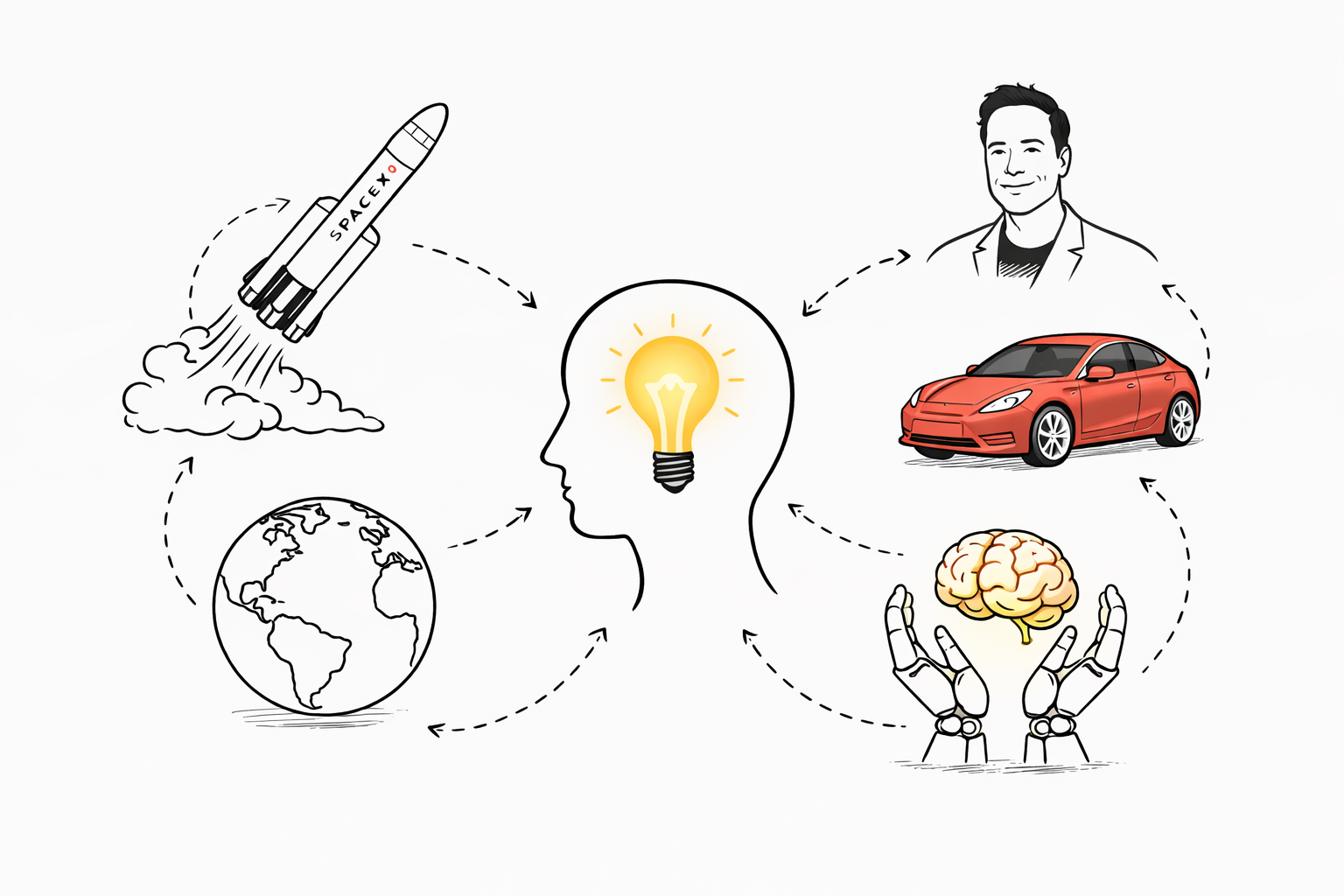
How to Think Like Elon Musk
Elon Musk doesn't just think differently—he thinks using specific, learnable frameworks. Here are the three mental models that power his approach to impossible problems.
1. First Principles Thinking: Question Everything
Most people solve problems by analogy: "We've always done it this way" or "That's how the industry works."
Musk starts by asking: "What is actually true? What are the fundamental physics?"
The Battery Example
When Tesla needed cheaper batteries for electric cars, experts said: "Battery costs $600/kWh. That's just what they cost."
Musk's first principles approach:
- Question the assumption: Why do batteries cost $600/kWh?
- Break down to elements: What are batteries made of? (Nickel, cobalt, lithium, carbon, polymer)
- Calculate raw material cost: Materials on commodity markets = $80/kWh
- Insight: We're not buying materials efficiently. We need to manufacture batteries ourselves.
Result: Tesla now produces battery cells for under $100/kWh—an 80% cost reduction.
How to Apply It
Next time you face a "That's just how it is" problem:
- Identify the assumption everyone takes for granted
- Break it down to physical components or fundamental truths
- Rebuild from first principles without the assumption
2. Reasoning from Constraints: Embrace the Limits
Most entrepreneurs ask: "What can we do with our current resources?"
Musk asks: "What would need to be true for this to work?" Then he works backward.
The Mars Example
Goal: Make humans multiplanetary Constraint: Rocket costs are too high
Instead of accepting high costs, Musk identified the real constraint: reusability.
Question: What if rockets could be reused like airplanes? Answer: Space travel costs could drop 100x
From this constraint-based reasoning, SpaceX was born. Now Falcon 9 boosters land themselves and fly again within weeks.
Your Turn
For your next big goal:
- Identify the true constraint (not just the obvious limitation)
- Ask: "What would need to be true?" for that constraint to not matter
- Design your solution to remove or bypass that constraint
3. The Iterative Mindset: Optimize, Don't Perfect
Musk doesn't wait for the perfect solution. He builds, tests, learns, and iterates at extreme speed.
SpaceX's Rocket Testing
Between 2006-2008, SpaceX's first three Falcon 1 rockets exploded. Most companies would have quit.
Musk's response:
- Analyze each failure in detail
- Identify the single biggest point of failure
- Fix it and launch again quickly
Result: The fourth rocket succeeded, won NASA contracts, and saved SpaceX.
The "Build→Test→Learn" Loop
Traditional approach: Plan for 2 years → Build for 2 years → Launch once
Musk's approach: Build for 3 months → Test → Learn → Improve → Repeat
More iterations = faster learning = better outcomes.
The Combined Framework
When Musk faces an "impossible" problem:
- First Principles: Strip away assumptions, get to fundamental truths
- Reason from Constraints: Identify the real limitation, then solve for it
- Iterate Fast: Build, test, learn, improve—don't wait for perfection
This isn't magic. It's a learnable system.
Practice These Models
Want to internalize how Elon Musk thinks? Try interactive scenarios with his mental models on Think Like ___.
Chat with an AI mentor trained on Musk's thinking patterns. Apply first principles to your real challenges.
Start practicing → Try Elon Musk Mentor
Sign in to like this post
What Are Mental Models? Your Guide to Thinking Like the World's Best
Next →5 Decision-Making Frameworks from Tech Leaders
Want to Master These Mental Models?
Learn how to think like Elon Musk, Steve Jobs, and other tech leaders through interactive lessons and AI-powered mentorship.
Start Learning →